
 IN
IN
 SG
SG
 ES
ES

A practical, guide to what the Carbon Border Adjustment Mechanism means for Indian manufacturers and exporters in 2026 – and why reliable carbon data is becoming part of market access.
CBAM has moved from preparation to execution. The European Union’s Carbon Border Adjustment Mechanism entered its definitive regime on 1 January 2026. For Indian exporters, however, the most important shift is not simply that CBAM now carries a financial dimension. It is that carbon information linked to the goods being sold into Europe increasingly has to be measurable, documented and, where actual emissions are used, independently verified.
That makes CBAM a data and operating-model issue as much as a regulatory one. In August 2026, the European Commission published a new set of implementation guides for non-EU installation operators and separate verification guidance. India’s Department of Commerce, together with NABCB and EEPC India, also held a dedicated exporter-awareness session covering embedded emissions, data collection, reporting, accreditation and verification. NITI Aayog’s September 2026 Trade Watch then identified CBAM preparedness as part of the competitiveness challenge facing India’s metals sector.
Quick answer: What is CBAM?
CBAM stands for Carbon Border Adjustment Mechanism. It is the EU system that places a carbon price on the embedded emissions of selected carbon-intensive goods imported into the European Union. The definitive regime applies from 1 January 2026. Formal declaration and certificate obligations generally sit with the EU importer or relevant indirect customs representative, while non-EU producers become critical sources of the emissions data used in those declarations.
Why CBAM 2026 matters now for Indian exporters
India’s exposure is concentrated in sectors where both trade volue and carbon intensity are significant. NITI Aayog reported that India’s merchandise exports to the EU reached USD 84.7 billion in 2025. Within CBAM-relevant product categories identified in its analysis, iron and steel exports were about USD 3.9 billion and aluminium about USD 1.06 billion. The same report estimates that the EU accounts for roughly 22% of India’s combined steel and aluminium exports.
The carbon-intensity challenge is also material. NITI Aayog places the average emissions intensity of Indian crude steel at approximately 2.5–2.6 tonnes of CO₂ per tonne of crude steel, reflecting the continued importance of coal-based steelmaking routes. Its analysis also highlights electricity-intensive aluminium production and monitoring, reporting and verification constraints as areas of exposure.
Who is actually responsible for CBAM compliance?
A common source of confusion is the legal responsibility. Under the EU definitive regime, EU importers – or their indirect customs representatives—who exceed the applicable single mass-based threshold of 50 tonnes for relevant CBAM goods must apply for authorised CBAM declarant status. Authorised declarants report embedded emissions and surrender the corresponding CBAM certificates.
Indian exporters do not generally purchase the EU CBAM certificates themselves. Their operational role is different but still important: the manufacturing installation outside the EU need to provide the emissions information on which the EU importer’s declaration depends. If actual emissions are used instead of default values (provided by CBAM), the non EU producer must provide third-party verified emissions data.
Why this distinction matters
CBAM can therefore reach an Indian manufacturer through customer (EU importer) data requests even when the formal filing obligation sits in Europe. For exporters, the practical question is: can the company produce defensible emissions information for the exact goods and production processes behind an EU shipment?
The real CBAM challenge: corporate carbon data is not automatically product carbon data
Many large companies already prepare organisational greenhouse-gas inventories for sustainability reporting, investor disclosures or internal decarbonisation programmes. That is valuable – but it does not automatically create a CBAM-ready dataset.
The EU’s 2026 calculation methodology requires operators using actual emissions to monitor emissions at installation level, identify the relevant production process and attribute those emissions to the covered goods. For complex goods, the methodology can also bring relevant precursor emissions into the calculation.
| Area | Corporate GHG inventory | CBAM embedded-emissions data |
| Primary unit of analysis | Organisation / reporting boundary | Installation, production process and covered good |
| Typical objective | Measure and report organisational emissions | Determine emissions embedded in covered goods |
| Data granularity | Often aggregated by entity or facility | Requires attribution to production processes and goods |
| Supplier / precursor data | Depends on reporting scope | Needed for complex goods |
| Verification | Depends on the reporting programme | Actual values used for CBAM require verification |
How CBAM embedded emissions are built
At a high level, the definitive-period methodology is as follows:
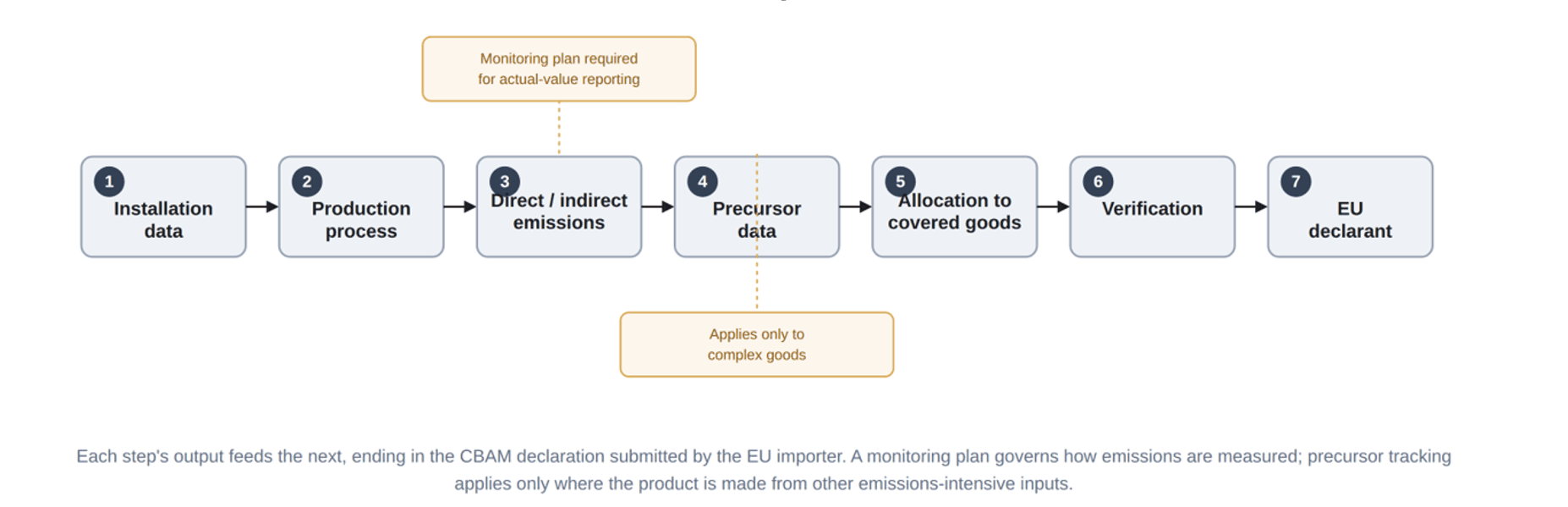
| Installation data | Production process | Direct / relevant indirect emissions | Precursor data | Allocation to covered goods | Verification | EU declarant |
The regulation requires system boundaries, production processes, monitoring methods and attribution rules. It also requires operators using actual values to design and implement a monitoring plan. For complex goods, relevant precursor quantities and emissions information need to be monitored as part of the calculation.
Challenge 1: determining exactly which exported goods are in scope
CBAM does not apply simply because a company belongs to a steel, aluminium or cement industry. Applicability depends on whether the specific goods fall within the CN codes listed in the CBAM framework. This makes product classification, installation mapping and production-route identification a foundational step.
Practical response: Create a CBAM applicability register that links each EU-bound product to its CN code, producing installation, production process, customer and data owner. This is not an additional legal requirement by itself; it is a practical control to organise the information the regulation requires.
Challenge 2: operational data is usually fragmented across teams
Embedded-emissions calculations rely on information that may sit in different systems and departments: fuel consumption, electricity use, heat flows, production quantities, material inputs, process data and supporting evidence. The CBAM methodology requires installation-level monitoring and a documented monitoring plan for actual values.
Practical response: Assign clear ownership for each input. Sustainability teams may coordinate the calculation, but production, energy, procurement, finance, export operations and IT often own the source data. A controlled data map should identify the source system, responsible owner, reporting frequency, unit of measure and evidence retained for every material parameter.
Challenge 3: precursor and supplier data can become the weak link
For complex goods, CBAM can require emissions information for relevant precursors. Where precursors come from another installation, the EU methodology specifies data points such as the producing installation, production route, reporting period, quantity used and specific embedded emissions. If required precursor data is incomplete or inconclusive, applicable default values may have to be used.
Practical response: Map critical precursor suppliers early. Introduce a standard data request covering the information required by the CBAM methodology, define evidence expectations and identify suppliers where actual data is unlikely to be available. Supplier engagement should begin before an EU customer requests a final verified figure.
Challenge 4: actual emissions versus default values is a strategic data-quality decision
Default values or actual verified emissions, subject to the applicable rules can be used. When actual values are used, the non-EU producer must provide verified emissions data.
Default values are not neutral placeholders. Under the corrected 2026 rules, default values used for cement, iron and steel, aluminium and hydrogen are increased by a 10% mark-up for 2026; fertilisers carry a 1% mark-up.
That does not mean actual values will always be lower than defaults. The outcome depends on the installation’s real emissions performance. But for lower-carbon producers, the ability to demonstrate actual emissions can become commercially important because it allows the carbon intensity of the specific installation to be reflected rather than relying on a conservative default.
Challenge 5: verification raises the standard of carbon-data governance
CBAM verification takes place at the level of the non-EU installation. Accredited verifiers assess the monitoring approach, emissions calculations and supporting evidence before issuing a verification report. The European Commission states that accredited CBAM verifiers could begin registering in the CBAM Registry from September 2026, with first verification reports for 2026 data available from January 2027.
Practical response: Treat every material emissions figure as an auditable data point. Keep source records, calculation logic, emission factors, assumptions, methodology changes, approvals and evidence in a controlled trail. Run an internal pre-verification review before the formal assurance process begins.
What could CBAM cost? Use certificate prices carefully
CBAM certificate prices are linked to EU ETS auction prices. The European Commission published a Q1 2026 price of €75.36 per tonne of CO2 and a Q2 2026 price of €75.28 per tonne of CO2 . The Q3 2026 price is scheduled for publication on 5 October 2026. In 2026 prices are quarterly; from 2027 they move to weekly calculation.
A simple ‘embedded emissions × certificate price’ calculation is useful only as a rough sensitivity check-not as a final CBAM bill. The final obligation can also reflect the CBAM benchmark/free-allocation adjustment and eligible carbon prices effectively paid in the country of production.
2026 compliance timeline
2026: non-EU operators monitor and calculate embedded emissions.
September 2026: accredited verifiers can register and verification work can begin.
January 2027: first verification reports can be issued.
February 2027: authorised declarants can purchase certificates for 2026 imports.
30 September 2027: first CBAM declaration covering 2026 imports is due, together with surrender of the corresponding certificates.
A practical CBAM readiness framework for Indian exporters
A useful way to prepare is to organise CBAM around six connected capabilities. Each step below is tied to an underlying requirement in the definitive-period framework rather than being a generic ESG checklist.
| Readiness area | What to establish | Why it matters | Regulatory / framework anchor |
| 1. Product scope | CN-code, installation and production-process map | Prevents scope and attribution errors | EU CBAM definitive regime; Reg. 2025/2547 |
| 2. Monitoring plan | Methods, boundaries, data sources and responsibilities | Creates a repeatable basis for actual-value calculations | Reg. 2025/2547, Art. 5 |
| 3. Data lineage | Source records, units, owners, calculations and evidence | Makes figures traceable and reviewable | CBAM verification framework |
| 4. Precursor readiness | Supplier data requirements and gap tracking | Supports complex-goods calculations | Reg. 2025/2547 precursor rules |
| 5. Verification readiness | Internal review and evidence pack | Reduces surprises during independent verification | CBAM verification guidance |
| 6. Carbon-performance improvement | Identify high-emission processes and decarbonisation levers | Supports competitiveness where actual emissions are used | India Green Steel Roadmap / Taxonomy |
From CBAM compliance to carbon competitiveness
The strongest response to CBAM is not only better reporting. It is using the same data to identify where embedded emissions are coming from and where they can be reduced.
India’s Ministry of Steel has already set out a decarbonisation roadmap covering energy efficiency, renewable energy, green hydrogen, material efficiency, process transition, carbon capture, utilisation and storage, and biochar. India’s Green Steel Taxonomy defines green-rated steel as production below 2.2 tonnes of CO₂e per tonne of finished steel, with progressively higher ratings at lower emissions intensity.
For exporters, this creates a useful link between compliance and strategy: CBAM data can show which installations, processes, electricity sources or precursor materials drive the carbon intensity of a product. That makes the same dataset relevant to customer discussions, capital planning and decarbonisation priorities.
What Indian exporters should prioritise in the next 90 days
>> Confirm whether EU-bound products are within the relevant CBAM CN codes and identify the producing installation.
>> Decide which customers or shipments are likely to rely on actual verified emissions rather than Commission default values.
>> Build or update the required monitoring plan and define data owners across sustainability, production, energy, procurement, finance and export teams.
>> Test whether production, energy and precursor data can be traced back to evidence for the 2026 reporting period.
>> Identify data gaps early—especially supplier and precursor information—and agree a remediation plan.
>> Prepare for verifier review by checking the calculation methodology, source records, version control and evidence trail.
>> Use the emissions results to identify operational decarbonisation opportunities rather than treating CBAM as a reporting-only exercise.
The central takeaway
For Indian exporters, CBAM 2026 is increasingly a test of carbon-data readiness. Understanding the regulation is necessary, but market readiness depends on whether an organisation can connect its installation data, production processes, precursor information and evidence into a calculation that can withstand verification and be communicated to an EU customer.
That is why the most useful question is: “Can we explain and substantiate the carbon embedded in the product we sell into Europe?”
Organisations that can answer that question confidently will be better placed to respond to customer requests, manage compliance uncertainty and turn carbon information into a broader competitiveness tool.
Frequently Asked Questions about CBAM
What is the full form of CBAM and what does it mean?
CBAM stands for Carbon Border Adjustment Mechanism. It is the European Union’s system for applying a carbon price to the embedded emissions of selected imported goods, helping align the carbon cost of imports with the EU Emissions Trading System.
Does CBAM apply directly to Indian exporters?
The formal EU declaration and certificate obligations generally sit with the authorised CBAM declarant in the EU. However, Indian producers of covered goods need to provide installation- and product-linked emissions data to their EU customers.
Which sectors are covered by EU CBAM in 2026?
EU CBAM covers selected goods in cement, iron and steel, aluminium, fertilisers, electricity and hydrogen. Applicability depends on the specific CN codes listed under the regulation.
What is the 50-tonne CBAM threshold?
Under the definitive regime, EU importers or relevant indirect customs representatives importing more than the single mass-based threshold of 50 tonnes of relevant CBAM goods are required to apply for authorised CBAM declarant status.
How are embedded emissions calculated for CBAM?
Emissions are monitored at installation level, attributed to the relevant production process and then allocated to covered goods. Direct emissions, relevant indirect emissions and, for complex goods, precursor emissions can form part of the calculation depending on the applicable sector and methodology.
Can default emissions values be used instead of actual emissions?
Yes, Commission default values can be used where the rules allow. For 2026, default values in cement, iron and steel, aluminium and hydrogen carry a 10% mark-up, while fertilisers carry a 1% mark-up.
Do actual CBAM emissions need independent verification?
Yes. Where actual emissions are used, the producer’s emissions data must be verified under the CBAM verification framework by an appropriately accredited verifier.
When is the first annual CBAM declaration for 2026 imports due?
EU importers must submit the first CBAM declaration covering 2026 imports by 30 September 2027 and surrender the corresponding CBAM certificates.
Is an organisational Scope 1 and Scope 2 inventory enough for CBAM?
Not necessarily. A corporate inventory is useful, but CBAM embedded emission calculations require data connected to the installation, production process and covered goods. Complex goods can also require relevant precursor information.
Is EU CBAM the same as UK CBAM?
No. The UK is introducing a separate Carbon Border Adjustment Mechanism from 1 January 2027. Its policy design, sectors, thresholds and calculation rules are separate from the EU CBAM framework.