The Reckoning: Reflections from Bloomberg's Sustainable Business Summit Singapore 2026
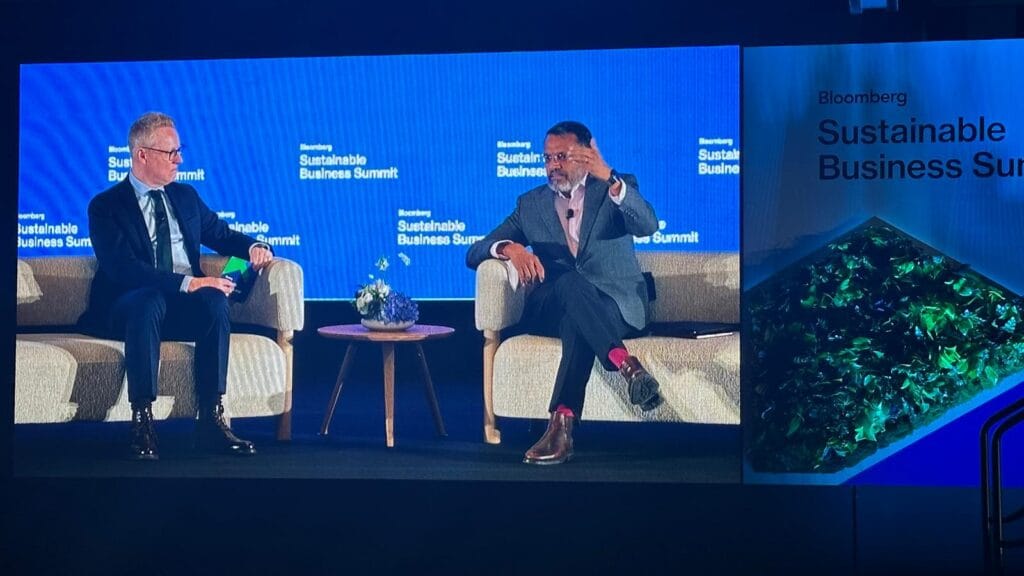
Ravi Menon, Singapore’s Ambassador for Climate Action, framed it plainly. Yes, the Strait of Hormuz dominates headlines as a supply chain flashpoint. Yes, geopolitical fragmentation is reshaping globalization. But if we don’t act on climate now, he suggested, every other resilience strategy becomes academic. The supply chain disruption due to climate will be unprecedented and something business leaders need to plan for now.
VinFast’s Anne Pham told a story about affordability colliding with adoption.
The EV Story No One Expected
The morning panel at Bloomberg’s Sustainable Business Summit opened with an uncomfortable truth: Mother Nature is not our biggest competitive threat—she is our extinction event.
The Reckoning: Reflections from Bloomberg's Sustainable Business Summit Singapore 2026
Ravi Menon, Singapore’s Ambassador for Climate Action, framed it plainly. Yes, the Strait of Hormuz dominates headlines as a supply chain flashpoint. Yes, geopolitical fragmentation is reshaping globalization. But if we don’t act on climate now, he suggested, every other resilience strategy becomes academic.
It was a sobering counter to the usual C-suite narrative about supply chain diversification and tariff hedging. Yet sitting in that ballroom on July 22, I realized something was already happening on the ground—companies weren’t waiting for perfect policy alignment.
VinFast’s Anne Pham didn’t give a sustainability lecture. She told a story about affordability colliding with adoption. Founded in 2017, it is one of the fastest growing electric vehicle manufacturer in Asia. Its growth story is incredible to hear!
VinFast’s expansion into India and Indonesia signaled that the energy transition won’t be a Western led narrative anymore. It’s a regional imperative. This wasn’t Silicon Valley dreaming. This was Asia waking up. Middle East fuel costs, driven by conflict driven volatility, are accelerating EV adoption faster than any subsidy ever could. Necessity, it turns out, is the best business model.
The EV Story No One Expected
David Fogarty, CEO UN Global Compact Chapter Singapore on the panel spoke on redesigning for resilience talked about treat suppliers as partners, not just vendors. This was specially true for SME’s who are an important part of the supply chain story.
The data points were striking. Leading companies are investing in supplier capability and sharing knowledge rather than simply blacklisting those who miss environmental targets. Genevieve Chua shared a powerful example: when uncertainty hit in 2015, Asian suppliers stayed committed—because years of credibility had been built on trust, not contract language.
This reframed the entire supply chain conversation. Resilience isn’t a fortress; it’s a network. It’s built before the crisis hits, through relationships and shared knowledge. And in an age where climate, workforce pressures, and supply disruption compound each other, organizations that treat suppliers as partners will anticipate disruption, while those who don’t will only react to it.
Resilience is indeed a team sport.
When Resilience Becomes Personal
Ho Kwon Ping of Banyan Tree Holdings offered a masterclass in playing the long game.
His philosophy was uncompromising: “Sustainability is not peripheral to business performance. It is part of how long term value is protected and created.”
Banyan Tree’s 20 year reporting legacy, now covering 100 properties across 24 countries, reflects this. But what struck me was the regeneration work—transforming a UN designated “unfit for development” abandoned tin mine in Phuket into a thriving ecosystem through tree planting and thoughtful design. That’s doubling down on a belief that environmental and social sustainability directly impact financial resilience.
The Long Game
Three perspectives emerged from that day: adoption at scale, resilience through partnership, and sustainability as fiduciary duty. None of them felt like aspirational talk. All three reflected companies already making strategic choices in an uncertain world.
Mother Nature, as Ravi Menon reminded us, doesn’t negotiate. The business leaders assembled in Singapore were already in motion, building the systems to survive what’s coming.
That’s a story worth telling. And of course thanks to Bloomberg for arranging this very insightful dialogue with industry and policy experts.
From the desk of Deepika Chawla, Head- APAC SAM Corporate.

 IN
IN
 SG
SG
 ES
ES